|
Home
History
Environmental Threat
Site Characterization
Man. Gas Processes
Plant Wastes
Contamination Threat Modes
Residuals - Components
Sources of MGP Liquid Effluent
FMG Plants in the US
Parallel MG Technologies
Think you've found a gas works?
Locating and Confirming a Site
Locations of US Gas Plants
FMGP In The News
FMGP In The Arts
Coal-tar Site Litigation
Related sites on the Internet
Literature of Manufactured Gas
Hatheway Harangues
Publications by Dr. Hatheway
Slide Shows by Dr. Hatheway
Slide Shows by others
Hatheway Bio
Hatheway Resume
Legal Considerations
|
|

Art Treats Gas Manufacturing
 There is a small but profound "corner" of the graphic arts world that has been fascinated by the overwhelming characteristics and qualities of industrial plants. Most of the treatments do not venture beyond somber statements of muted tones and what most of us would recognize as drab and dreary confines of repetitive labors of "other people" with whom we no longer readily identify. There is a small but profound "corner" of the graphic arts world that has been fascinated by the overwhelming characteristics and qualities of industrial plants. Most of the treatments do not venture beyond somber statements of muted tones and what most of us would recognize as drab and dreary confines of repetitive labors of "other people" with whom we no longer readily identify.
Setting aside the compulsion of many artists to make their art in a dimension of social comment, there also is a broad artist approach toward portraying the contrasts of nature represented by some pre-existing ("greenfield" or pre-industry) colorful or otherwise visually striking aspect of the juxtaposition of industrial subjects such as gas works, and the remaining presence of the natural world in which they sat. Water tends to be the subject medium that lured many of the artists toward paintings in which gas works are seen in a colorful array of tones setting the gas works as a mammoth intruder perched on the edge of moving waters.
We hope to expand this treatment as our research and the efforts of our website identify other examples, both major and minor; after all, our interests are in the subject primarily, then we will share what it is we know of the artist."
In presenting these images for your enjoyment, Dr. Hatheway has followed the usual art world courtesy of offering the images solely for your personal enjoyment and edification and notes that this website "....takes in no advertisements and has no sponsors, does not charge a fee for services, and does not offer any product or service for sale." The images presented herein remain unaltered, save for a uniform thumbnail size, and he has included all of the accompanying caption information that we have been able to secure with regard to each work of art so presented for your personal use."
Should you come across any suitable examples of "Gas Manufacturing Art" that you do not see on these pages, we encourage you to submit your findings for inclusion in our growing collection. With "Contributed by:" credit, of course.
Email: [email protected]
Fax: (573) 341-2071 |

|

|
Paul Signac (Parisian; 1863-1935;
active as an artist after 1880)
"Gas Holders at Clichy".
Paul Signac has a following of art lovers who enjoy his displays of light and color, by which the subject becomes only the means to support the display. We are fortunate that Signac had access to a canal house on the banks of the Seine, just opposite the great walled gas works at Clichy, the north-side suburb of Paris, where he blocked in the towering gas holders (of which there were nine in 1887) the year he gave us "Gas Holders at Clichy".
|
This scene is basically similar to perhaps at least half the former manufactured gas plants of the world, in that water was an integral part of gas manufacturing, increasing in volume as the general progression occurred from coal gas and early oil gas processes, into carburetted water gas. Gas plant operators were uniformly faced with the need to manage their "ammoniacal liquors" (at coal-gas works and coke-oven plants) and with "gas liquors" at carburetted water gas plants. It was common knowledge that these liquors had damaging properties and characteristics in terms of discharge "to the ground" or as discharged to surface waters, but many plant operators took those calculated risks, especially where the gas works bordered a stream, river, lake or swamp. |
|
William S. Schwartz (Russian/American, 1896-1977),
Gas Factory, circa 1948; oil on canvas, signed;
30" x 36", titled and dated verso.
Important Chicago modern painter and printmaker. Schwartz studied at the Art Institute of Chicago, and exhibited extensively throughout the 1920s-40s. His work is included in the collections of the Art Institute of Chicago, Detroit Institute of Art, Library of Congress, Dallas Museum of Fine Art, Biro-Bidjan Museum (Russia), and the Department of Labor . "Gas Factory" sold for $33,600 at Treadway-Toomey Galleries 20th Century Art & Design Auction on March 5, 2006, in Oak Park, Ill. Full text HERE
- Tamera Harrod (Treadway-Toomey Galleries)
Courtesy: www.treadwaygallery.com
|

|
The Schwartz painting could well be one of the some 200 manufactured gas plants that dotted the map of Illinois, in recognition of the plentiful bituminous goals available in the State for use in conversion to artificial gas used for residential and business lighting, heating of homes, water and cooking, and as an industrial fuel, all before the general arrival of natural gas in the State, beginning in 1931. Most of the large number of town gas plants were privately owned and continued in operation until about 1955. The view shown here is evocative of one of these plants in the 1940s, and its tall buildings tell us that the plant had converted to the process known as carburetted water gas and that its location on a stream or river bank was also very common, as water was used to cleanse the unwanted and objectionable tars from the gas and also, in far too many cases, as a discharge point for the toxic gas manufacturing liquid effluents. Gas works were central to the well-being of most towns but each today require diligent attention toward environmental remediation. |
|

|
Gas Works Linoleum Cut
in the style of Thomas Hart Benton.
Allen Hatheway found and purchased this 1930s example of prairie-art impressionism at Portland, Oregon, in 1993, and is still searching for a clue to its origin and creator, not withstanding the fact that his personal research has, to date, turned up 37 historic gas works and other coal tar sites in the City of Roses. We view this gas works from its "back side" peering around and through the two large gas holders, both being multi-lift (telescoping), above-ground, water-seal varieties common to the era of 1890-1920.
We can conjecture that the puff of smoke reveals a carburetted water gas plant on its blow cycle and making use of bituminous coal for the generator bed, in lieu of the inventor's recommended coke.
|
| The puff of smoke (provokes us to look for today's likely evidence of tar-water emulsions (from the use of coal instead of coke, and also possibly heavy oil instead of the recommended light oil for carburetion). These departures were made as deliberate choices by the gas works operators, who then were faced with the valueless and unwanted tar-water emulsions. Many operators made the decision not to spend time and effort to treat the tar-water emulsions and therefore elected to discharge them "to the ground." This choice resulted in countless instances of lasting environmental pollution, when the could-have-been by-products of the tar-water emulsion residuals became, in fact, wastes. |
|
Harry Leith-Ross (1886 - 1973, New Hope, Pennsylvania)
"Gas Works"
Watercolor on paper
20 x 26 inches
Signed at lower right
Private collection, Bucks County, Pennsylvania |
 |
| Harry Leith-Ross was born on Mauritius, of Scottish parentage and favored life images in virtually all media. Leith-Ross was educated in the best English schools, had access to the family castle in Scotland, and trained for a technical career in the coal production. The artist emerged in 1913 and from that point onward he made his life solely in art, teaching at his every location and, as well, at the University of Buffalo and the University of Utah. His travels were worldwide, but it is known that he spent the majority of his life in eastern Pennsylvania, emigrating there with his wife in 1935 and associating with what has become known as the Pennsylvanian Impressionists, mostly in Bucks Country, around New Hope (about 55 km NNE of Philadelphia). Because of this location and the artist's known affinity to waterscapes, this view may represent a portion of the former Point Breeze Gas Works (est. 1851), operated on the east shore of the Schuylkill River, just north of W. Passyunk Avenue and west of the former 32nd St., in northern Philadelphia, by the United Gas Improvement Company (U.G.I.) of that city. |
|

|
Caroline Johnson (1947 - , Brittany, France)
"Gas Holders at Salford"
Contributed by the artist.
The two gas holders are at the corner of Liverpool road
and Cross Lane, Salford, Manchester.
Painting Size: 43 x 58cm. Mixed media on paper. (£600)
Currently part of the artists personal collection. |
Caroline Johnson was raised among mills, car plants and rubber works, Ms. Johnson studied fine Art at Preston, Falmouth and Central College of Art, London. She was a member of the Ladywell Studios in Preston, worked as a Life Model and Drawing tutor, then took off to live in Brittany. She has two grown-up children and a partner who is an artist and songwriter.
The Artists Statement:
"Lowry's downcast crowds on the white pavements had little energy left for the elegance of the urban or the grace and symmetry of the functional. It was up to him, the artist to say, look, here is beauty among the mediocre and the commonplace. My crayon, my paint seek out the dusty forgotten corners of the city and its fresh shimmering heights and I give them life and restore them to you the passer by, the man returning home from work , the busy shopper and the clubber out for fun."
"Ladies and gentlemen, I present the city's passing parade! The charm of a humble nettle growing out of the pavement, creeping shadows, forgotten doorways and broken fences. The watchful solidity of a gasworks and the resplendence of red brick , the mystery of parked cars, the enigmatic shapes of the renewed and the newfangled- and the glittering giants against the steadfast skies."
- Caroline Johnson June 2007
[email protected] |
|
|
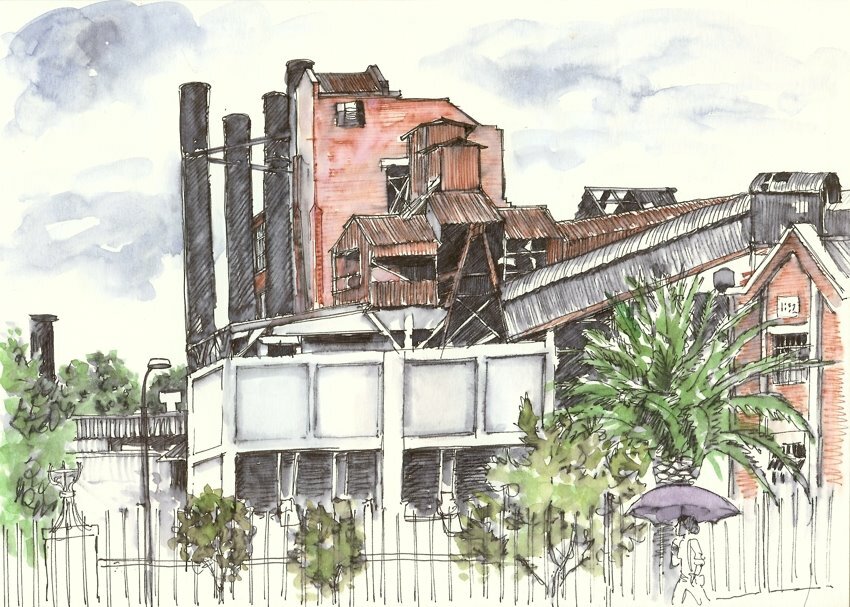
Cathy Gatland (2009 Johannesburg, South Africa)
"The Old Gasworks"
"This rather tatty looking building is one of the landmarks of Johannesburg. Before 1964, gas to supply the city was manufactured here from coal..."
- Cathy Gatland
Visit the artist's blog site for her full description.
|

|
|
| |

|
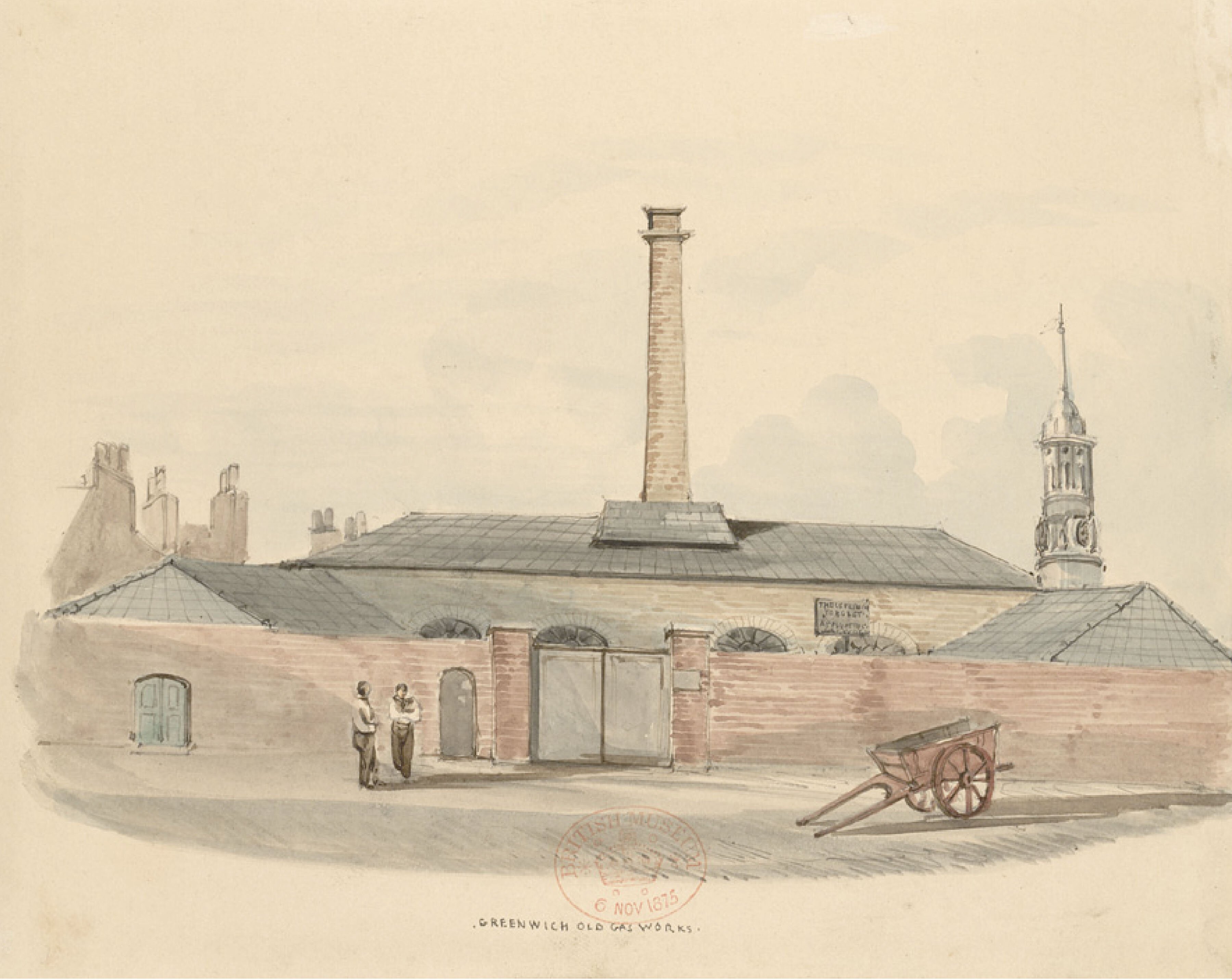
Chunnell (full name of artist unknown, c.1841 London)
"Greenwich Gasworks"
East Norway Street
A Derelict Greenwich Gasworks; resultant of the early "gas rush"
to illuminate the neighborhoods of London.
c. 1841 watercolor by one "Chunnell" shows the
derelict gasworks as an advertised rental property.
|
|
"This small gasworks probably stood on the east side of Norway Street in Greenwich between c.1823 and c.1828. The first public supply gas works were developed in London from 1811. Within ten years speculators had appeared who offered to build gas works in towns and communities to be subsidized by finance raised locally through various deals. In Greenwich two such speculators approached the Greenwich Vestry (the local authority) and the resulting row escalated into Government action (a writ of mandamus) and the downfall of the ruling group in the vestry. The Norway Street works was taken over by a larger company within a year of construction and used while the rival works was rebuilt the other new works was slipping into Deptford Creek as quickly as it was built. By 1828 the Norway Street works was no longer in use as a gas works and was advertised to rent - described as a valuable property at Greenwich near the river Ravensbourne with brick buildings and a lofty chimney suitable for an iron foundry or any trade requiring large premises. It was eventually sold. The rival gas works built by the Phoenix Company in Thames Street was to flourish and did not close until the First World War. By that time gas supply had been taken over by other and larger concerns in this part of south London it was eventually superseded by George Livesey's magnificent works on the Greenwich Peninsula."
- Text by Dr Mary Mills with thanks to Brian Sturt and Julian Watson
|
|
|
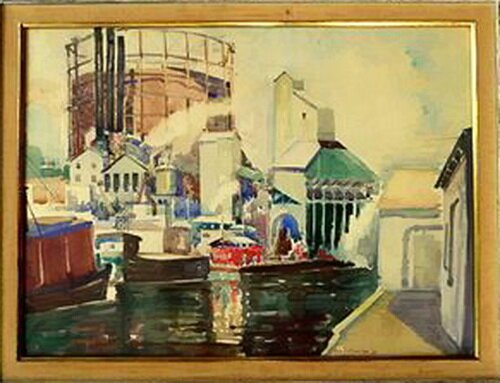
Theo L. Soontup (1938 Brooklyn, New York)
"Gowanus Canal East Gasworks"
The following description comes from an eBay auction description before the painting was sold to an unknown buyer in February of 2009 for $350:
"An original watercolor painting from 1938 of the Gowanus Canal East in Brooklyn, New York, and signed by the artist Theo L. Soontup. Masterfully done, this painting is a bit of history as this part of Brooklyn has had many ups and downs over the years. Google the Gowanus canal to read some of the interesting tidbits. This painting measures 16.5" by 22.5" inside the matting, glass, and frame."
|
|
|

|
Raphael Ellender (1906-1972)
"The Gas Works" - approx. 14" x 18"
"Heavy Industry Gasworks; likely associated with a Pennsylvania steel mill. The image is watercolor on art board, executed and signed in 1938, as the work of New York City landscape and portrait artist Raphael Ellender (1906-1972). Foremost in the view appear to be a purifier box (left, frontal) and a tar residuals tank (center, front), with the diagnostic multi-lift, telescopic gas holder (likely an above-ground, water-seal variety, to the right background. Mr. Ellender was a regular Instructor and Lecturer at The Art Students League of New York (City), a participant in the Federal WPA Art Project, published two books (1964 and 1972) on drawing techniques, and his papers are held at the Smithsonian Institute, Archives of American Art. The present owner approached us in January of 2009 with her kind offer to share this view."
|
Note: Click each small painting to download a larger version.
|
|