|
Home
History
Environmental Threat
Site Characterization
Man. Gas Processes
Plant Wastes
Contamination Threat Modes
Residuals - Components
Sources of MGP Liquid Effluent
FMG Plants in the US
Parallel MG Technologies
Think you've found a gas works?
Locating and Confirming a Site
Locations of US Gas Plants
FMGP In The News
FMGP In The Arts
Coal-tar Site Litigation
Related sites on the Internet
Literature of Manufactured Gas
Hatheway Harangues
Publications by Dr. Hatheway
Slide Shows by Dr. Hatheway
Slide Shows by others
Hatheway Bio
Hatheway Resume
Legal Considerations
|
|

Parallel Manufactured Gas Technologies
ILLUMINATING GAS from "GASOLENE" and ACETYLENE
These two sources of gas lights are both of historic importance and also of today's environmental significance. The former factor is important because the presence of gasolene gas machines (1860-1915) and acetylene gas plants (1895-1940) did not typically generate toxic residuals and wastes for modern consideration. Yet, having said this, these gas plants, where installed to serve a community or small town, generally bore the name of "Gas Light Company," or, perhaps less commonly "Gas Company" and can today give pause for thought to environmental regulatory agency personnel charged with the responsibility of locating and characterizing literally all of the many (several hundreds of thousands) of pre-1970 "gas works" located throughout the world.
The minimal installation cost of a late 19th and early 20th century commercial (town) manufactured gas plant was in the range of U.S. $25,000 to $50,000 and this value was approximately pegged by the two equivalent factors; inflation (rising dollar cost) and value (greater plant value per dollar). Said another way, worldwide, after about 1875, the gas entrepreneur got more for the money in terms of gas generation capacity and this approximately kept up with the relatively small degrees of economic inflation of the times. Given this cost constraint, the greater percentage of the world's people literally never experienced any sight of gas lights, for they were farmers, herdsmen, stockmen, trading peoples, migrant peoples, and other isolated semi-rural dwellers whose small towns and farm and ranch homes were isolated geographically from human clusters able to afford a traditional gasworks.
 THE COMING of "BURNING FLUID" THE COMING of "BURNING FLUID"
Nevertheless, mid-19th century inventors began to work with schemes to take advantage of the newly discovered "light ends" of crude oil almost immediately coincidental with the world's first true discovery of systematically recoverable petroleum, that of Edwin Drake, at Titusville, NW Pennsylvania, in 1859. Distillation was a proven technology at the time Drake's first oil well created the Titusville "rush" and from these first wells sprung refineries, the stills of which included, among other products such as "snake oil" and other "medicinals", the highly valuable "burning fluid" and "burning oil" (kerosene and coal oil) and their more flammable "gasolene." Many of these light-end "oils" possessed high vapor pressures and were, in today's chemical parlance, VOCs; volatile organic compounds) having the dangerous quality of releasing combustible vapors at ambient pressure and temperature.
GAS MACHINES 
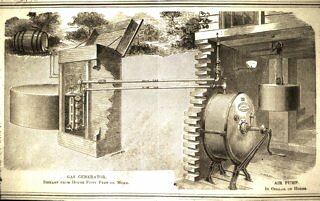
The next result, all happening within months of the end of year 1859, was a rash of patents for illuminating gas generators typically called gas machines, capable of producing local, small-cost, gas-light vapors. The broad name for these devices was gasolene gas machines and the general technology of "gasolene" gas lighting was well in place in North America and in England by 1860. Britain's advances in this new field occured mainly Scotland, and there from the burning oils being distilled from extracted shale-oil and coal-oil and beginning yet another stimulating sailing-ship trade to the empire, packaged in 5-gal. "tins" in two-tin crates. Gasolene gas machines went on the market for about a thousand dollars (£200) installed, in 1860 U.S. dollars. Accordingly, urban-isolated, suburban and rural hotels, tavern, resorts, military posts, naval stations, government offices, and the mansions of the rich, could now be gas lighted and there was a rush of those who could afford the luxury or the necessity, which, of course, did not include the "common man" of the times. The common man bought burning fluid and sought light from the multitude of cheap brass and glass lamps of the day, and people died by the thousands when such lamps tipped and spilled their flaming contents. The gas-light industry kept the "burning fluid" danger before the consuming public with frightening reports of "deaths by burning fluid."
Perhaps the greatest impacts of the gasolene gas movement were gained by the brilliant Massachsetts farm-boy inventor Hiram Maxim (later knighted by Queen Victoria) and his Springfield Gas Machine, manufactured at Boston and sold broadly and widely as a series of a few wooden crates easily shipped via railroad, canal barge, riverboat, and steamship, with ease of local delivery by team and wagon. The reader may remember that later on, Maxim created the "better" machine gun. Click image to view larger version.
ACETYLENE (CARBIDE) GAS LIGHTING
 At about 1895, a new market force entered the general scene of artificial gas, that of acetylene gas generators, which operated on powdered calcium carbide delivered in sealed, light-metal drums, and consumed from inexpensive rolled, corrugated-side, sheet-steel cylinders. Carbide lights made use of acetylene gas generation, a French invention. Most carbide sales went for miner's underground non-explosive head lamps, but the sales of gas-light acetylene generators became brisk by about 1910 and there was a proliferation of acetylene gaslight companies in North America England, and across Europe. Most of these companies took up names that now confuse us with the potential presence of coal gas, water gas, oil gas and producer gas plants, all of which present potentially serious environmental threats today, or at least until competently and thoroughly proven otherwise. At about 1895, a new market force entered the general scene of artificial gas, that of acetylene gas generators, which operated on powdered calcium carbide delivered in sealed, light-metal drums, and consumed from inexpensive rolled, corrugated-side, sheet-steel cylinders. Carbide lights made use of acetylene gas generation, a French invention. Most carbide sales went for miner's underground non-explosive head lamps, but the sales of gas-light acetylene generators became brisk by about 1910 and there was a proliferation of acetylene gaslight companies in North America England, and across Europe. Most of these companies took up names that now confuse us with the potential presence of coal gas, water gas, oil gas and producer gas plants, all of which present potentially serious environmental threats today, or at least until competently and thoroughly proven otherwise.
So, you see now that this presentation is made not only in the interest of a higher degree of historical understanding of manufactured gas, but toward the necessary screening of gasworks that may not present real and on-going threats to environmental and public health and safety."
Click image to view larger version.
|


