|
Home
History
Environmental Threat
Site Characterization
Man. Gas Processes
Plant Wastes
Contamination Threat Modes
Residuals - Components
Sources of MGP Liquid Effluent
FMG Plants in the US
Parallel MG Technologies
Think you've found a gas works?
Locating and Confirming a Site
Locations of US Gas Plants
FMGP In The News
FMGP In The Arts
Coal-tar Site Litigation
Related sites on the Internet
Literature of Manufactured Gas
Hatheway Harangues
Publications by Dr. Hatheway
Slide Shows by Dr. Hatheway
Slide Shows by others
Hatheway Bio
Hatheway Resume
Legal Considerations
|
|

Internet Links To Gas Works Sites Presently Undergoing Public AttentionOnce discovered in the course of urban renewal, land redevelopment or infrastructure improvement, former manufactured gas plants quickly rise to public attention and activities generally go to quick resolution, not always to favor the environment or public health, however.
Here are a selection of Internet sites that will allow you to judge the broad spectrum of response versus non-response.
Professor Hatheway would like to know of other links and will consider putting them up on this website for everyone's benefit.
---------------------------------------------------------------------------------
 The Archives (Click here to view other archived sites under public scrutiny) The Archives (Click here to view other archived sites under public scrutiny)
---------------------------------------------------------------------------------
September -- 2009: Jackson, Tennessee: "City Blissfully Covers-Up its Old Gasworks"
The Citizens' Gas light Company was established in 1868, as the Jackson Gas Light Co, some forty years earlier than its PRP, the City, is aware of! Meanwhile the two-acre gasworks sites, lying adjacent to the City's Farmers Market. The two-acre gas works is bounded by Farrar and Jones Streets, Union Avenue, and the Farmers Market, the latter of which was shut down in 2006 on discovery of free coal-tar. Now the City is going to cover up the gas works site with a $109,000 oil "cap" leaving the entire site otherwise unattended. Is the Tennessee Department of Environmental Regulation (DER) blissfully ignorant of this one? (Jackson Sun, 26Sep, 2009) (Full Story)
---------------------------------------------------------------------------------
June -- 2009: Gilford, New Hampshire: "The Gasworks Dump at Gilford, New Hampshire" 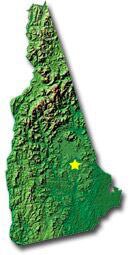
Gilford (formerly known as Guilford), a pleasant, small (6,900 pop.) bedroom community in New Hampshire's Lakes Region resort belt, never had its own commercial gasworks, nor did it have gas lights. Gilford, however, has suffered for the past sixty years with toxic effects of a gasworks dump and, since the 1970s, some citizens have lived atop the Liberty Hill gasworks dump.
National Grid, the aggressive British 21st century owner of much of America's gas distribution services in the Northeast, has back-loaded the Liberty Hill site into its New England Site Investigation & Remediation Program.
The dumping is believed to have occurred incident to the 05Mar, 1952 explosion of the second historic towne gasworks (1894) on Messer Street, in nearby Laconia.
At that time a 1902-era, custom-rigged carburetted water gas set (oldest of two at the plant in 1952) had been converted by the then-owner (from 1945), Gas Services, Inc., to serve as a high-btu oil-gas plant.
This was indicative of a regional trend in the Northeast, responsive mainly to the unacceptably-high cost of coal as a gas-manufacturing feedstock, and also of frequent labor-union strike interruptions in supply of gas coal or coke.
As a result of the wee-hours explosion, the plant required considerable demolitio n and cleanup in order for the owners to initiate a temporary butane-air gas supply to consumers.
In the meantime, GSI was sold to Energy North Natural Gas, Inc., which, much later, was purchased by KeySpan in 2000.
The dump came to light during a year-2000 Federal Court trial in which National Grid's immediate predecessor, the holding company KeySpan, sought to gain recompense from its insurance companies, fifty years after their period of accident and general liability coverage.
Environmental Journalist "Cutter" Mitchell, tracking the court case made the public-safety and environmental threat connections and eventually pieced together a string of local discoveries at Gilford, beginning in the 1970s, when the dump site was redeveloped for residential housing constructed on septic systems.
While KeySpan can be considered the victor in that 2000 case, with a $14 million judgment against the decades-old insurance policies, the net result was that the word "was out" concerning the demonstrated off-site removal and dumping of toxic gasworks tars.
Meanwhile, back at Laconia, much of the original Messer Street residual and waste tars are still suspected by Prof. Hatheway as being left untouched at Laconia no. 2, in the north, triangular portion of the gas yard, conveniently left unexplored during site and waste characterization, even though it has been through a NH DEP-monitored site remediation.
NH DEP took attention to the Liberty Hill dump site in 1999, and has since demanded an appropriate cleanup.
As of June, 2009, the Liberty Hill remediation picture had enlarged to estimates of as much as 121,000 tons of tar and tar-contaminated soil. As the remediation effort crept along, mainly with attention to how much could be saved by not directly seeking and addressing the truths of the tar dump contamination, the projected costs increased from the $10-13 million that KeySpan spent at Laconia, and the length of potential toxics exposure increased to some 30 years for some Liberty Hill residents. As for the Liberty Hill costs, the tactic of delay in comprehensive remediation has seen KeySpan's $2 million (spent to date) now to be judged at perhaps as much as $15 million, and nothing yet has been done to address the potential links to the well-known, long-term, human carcinogenicity of fugitive tar compounds.
---------------------------------------------------------------------------------
April -- 2009: Brooklyn, NY: "New NPL Site Proposed for Brooklyn's Nastiest Strip -- Gowanus Canal"
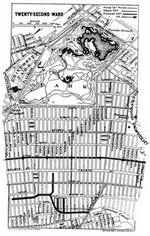
On 8 April, USEPA Region II's Proposal to list the 1.8-mile-long (Butler Street, westward to Gowanus Bay) Gowanus Canal was aproved by HQ, USEPA and the site now officially is in the Listing Process. In Professor Hatheway's estimation, the old canal sides and its vastly polluted sediment rate Number One attention, in competition with many other reeking gas-works-contaminated American sites. Mind you, two of the old Citizen's Gas Light Company plant sites (the 12th Ward Works; off 4th Place and Smith Street, near Hoyt St., and the 22nd Ward Works; 6th Street @ 2nd Ave.) The two site areas are shown here on two of the 1892 Brooklyn Ward Maps. Note: the 1892 22nd Ward map is shown at right and the 12th Ward map was previously published in February of 2008. Click here for map and related story. ( click either map to view an enlarged version )
It's hard to say how much of the news is part of the "Hope & Change" promises from the Obama administration, as EPA Region II is operating under an Acting Director, awaiting the disclosure of its Obama Administration leader. However, on 14 April we learned that NYS DEC Director Pete Grannis had personally asked USEPA Region II (NYC) to make the SUPERFUND NPL listing intervention, on 12 December, 2008, without the knowledge of Mayor Bloomberg's staff. It is clear, however, that the process of elevation to NPL status is the direct result of intense public scrutiny, thanks to citizen groups such as the Carroll Gardens Neighborhood Association, which, at this point appears to be worthy of applause for carrying this issue from "public concern" to "government action."
---------------------------------------------------------------------------------
 March -- 2009: Bury St Edmunds, Suffolk, UK: Once Famous East Anglia Gasworks Receives a New Life Without Concern" March -- 2009: Bury St Edmunds, Suffolk, UK: Once Famous East Anglia Gasworks Receives a New Life Without Concern"
Bury St. Edmunds is a western Suffolk County, East Anglican, English market town with a very old history, amongst which are a likely Roman villa, the ruins of the Benedictine Abbey of St. Edmunds (founded perhaps in 633, and later associated with the Saxon King St. Edmund, slain by marauding Danes (870) and a long forgotten early (1824) gasworks. For gasworks purists, the plant, off Tayfen Road, British gas historian Brian Sturt reminds us that the works established by the pioneer British gas engineers Thomas Snowden Peckston and John Malam, Sr. It was Peckston, in dealing with a glut of tar, who there further pioneered the concept of firing retort furnaces with gasworks tar, a practice we have learned that was not often followed, out of respect for the peculiarities of the practice leading to permanent damage to the furnaces. Peckston served the Royal Navy as a Civil Engineer and was the author of a string of prominent gas engineering books (1819, 1823, and 1841), and practiced through 1849. Malam, began his gas manufacturing career at the Chartered Gas Light & Coke Company of London (1814), practiced until 1841, and was sire to a large family of British gas engineers. The two men were brothers-in-law.
(Lifetime of Thomas Snowden Peckston, R.N.; Heritage Gas Times, no. 51, Jun, 2007, by Brian Sturt, p. 2)
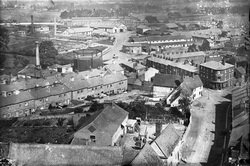
Dr. Hatheway has web-located what appears to be an 1890s view of the Bury St. Edmonds Gasworks, shown in a low-oblique aerial photo (perhaps taken from an observation balloon). The view is offered by the Bury St. Edmonds Past & Present Society as 'BRO_K505_1741- Birds-eye view of Bury: gasworks and station area.'
( click photo for enlarged version )
At the present time, all of this history apparently has been forgotten and the 5.3 ha. property containing the former gas works is known primarily as the site only of a redundant National Grid gas holder. Right now the Borough Council is looking to brighten-up the particularly shabby section of town (termed thusly by one of the elected Borough Councilors), with a newly constructed Aldi Supermarket, a budget motel and perhaps a hundred new homes. The site owner, National Grid, supports the concept, and nary a word was published about the intriguing coal-tar legacy-threat of the site. (Related Story)
---------------------------------------------------------------------------------
February -- 2009: San Francisco, California: "Coal Tar Controversy over Shoreline Sediment Contamination at San Francisco"
As is nearly always the case for FMGPs located along or near bodies of surface water, San Francisco's Potrero Gasworks (1872-1930) has a near-shore toxic PAH imprint that is reaching the conscience of local public leaders. Potrero Station was one of the but two San Francisco gasworks that remained operational directly after the great earthquake of 1906. The breaking story has been covered by San Francisco Chronicle Staff Writer Robert Selna (26Feb, 2009). (Full Story)
---------------------------------------------------------------------------------
January -- 2009: Canandaigua, New York -- se corner of state routes 5 & 20 @ south main street.
This town has two recognized FMGPs; both the plants of the former Canandaigua Gas Light company. USEPA discovered this first gasworks during its 1980 "records-and-windshield" surveys of Coal Tar sites; Wegman's the superb Gourmet Grociers was then in occupation of the site, as an "innocent" successor land-owner, as the gasworks (1853-1913) had been sold in 1952 and then demolished by in the 1960s, also by later site owners. USEPA judged the site as "NFRAP" - "No Further Remedial Action Planned" (meaning that it would not be sent to the National Priority List), and remedial responsibility was shifted to the ever-diligent NY State Department of Environmental Conservation NYSDEC) , the people who have the national reputation for working as hard and as fast as possible on removing coal-tar threats to the populace. DEC cranked up its efforts in 2007, and began to urge the historic operational owner, Rochester Gas & Electric co. (Now a unit of First Energy Corp.) to begin efforts to rid the site of the toxic gas-manufacturing residuals and waste left in the ground at the time the successor owner demolished the portions of the gas works that had been above ground. Wegman's still owns the ground, but moved its Gourmet Market to a new location about a mile further east, in 1992. The gas company is being held responsible for conducting a proper environmental site closure. (Full Story)
---------------------------------------------------------------------------------
January -- 2009: Derby, UK: "Garden Plots vs Tar Residuals"
Gardening has long been known to be a British cultural hallmark; it has salved their souls for centuries, rising from the time of Saxon need for sustenance, curried through two world wars, and now again rising in prominence with many Britons, old families and immigrants as well. Already in January, 2009, largely as a consequence to inflation of food prices and economic pressures from the falling world economy, English corporate (municipal) garden plots, known affectionately as allotments, have joined the long list of urban conditions under which gasworks dumps have begun to appear to the public attention.
First, two erstwhile elderly allotment gardeners in the City of Derby discovered what appeared to be tar residuals and, this made the news quickly. Only a week later, the pinch for citizen food cropping brought about attention to the possibilities of redeveloping all or part of the old Morley Street Gasworks in Walkley District of Sheffield, Yorkshire. Naturally, we'll be following this development, for what plagues English garden plots has no bar on appearing as yet another facet of the widespread gasworks dumps that are discovered elsewhere, on a frequent basis. (Full Story)
---------------------------------------------------------------------------------
January -- 2009: "UK, Lewes District Council, East Sussex bans certain historic road names as 'aesthetically unsuitable,' such as Gasworks Road, Coalpit and Tip House Lanes; others are even more direct and dire in challenging politically correctitude!"
"UK city council cracking down on rude/suggestive road names" by Frank Filipponio. On Jan 7th 2009 at 8:57AM The Lewes District Council in East Sussex, England, has just banned whores in their district, although they don't seem to mind seeing jugs every now and then. Actually they decided to ban Hoare Road because of the potential homonymic mix-up with ladies of the night, but felt that Juggs Road was okay. In an effort to clean up the smut all around them, the Council has just enacted a measure to ban suggestive, rude or just unpleasant road names from the map. Among the banned names are Gasworks Road, Tip House and Coalpit Lane, all of which were deemed 'aesthetically unsuitable,' as well as 'names capable of deliberate misinterpretation,' like the aforementioned Hoare Road and Typple Avenue, Quare Street and Corfe Close. Juggs Road and Cockshut Road will inexplicably remain. (Full Story)
---------------------------------------------------------------------------------
January -- 2009: Ipswich, Southeast Queensland, Australia: "Two images of salvaged gasholder guide frame as part of the new Riverlink Shopping Centre"
The 1877 gasworks operated as a coal gas plant until replaced in the late 1970s with natural gas. An early 1950s gasholder guide frame was salvaged and installed at the replacement site landuse, the Riverlink Shopping Center, along the Bremer River, about 35 km west of Brisbane. The Making Progress blogger provides us with a couple of images of the historic ambiance provided by just the gasholder guide frame (Full Story)
---------------------------------------------------------------------------------
January -- 2009: Gasworks Dump; Beechworth, Victoria, Australia: "Community back into the swim of things"
Brad Worrall - 5/01/2009 - Beechworth pool is going just swimmingly this summer. Little more than 12 months since investigations into a crack in the pool shell found contaminated soil and closed the pool for the summer it is again open. Numbers during the peak Christmas and New Year break were higher than usual. Leo Belci lives across the road from the pool and his children, 4 and 7, use the pool most days. We use the pool every day so last year was extremely sad for the kids, he said. We knew, or at least hoped, it was short term but for them the whole summer without the pool was pretty traumatic. But with the money the council got to fix the pool it also fixed the solar heating so I don't think we have missed a day since it reopened this summer. The water is somewhere between 21 and 24 degrees, just perfect. A plastic liner overcame the crack in the pool, while the polluted soil could be contained without excavation. The pool was built on a former tip site that contained waste from the old Beechworth gasworks. (Full Story)
Professor Hatheway Comments: We are now seeing the appearance of what we know is to be expected to be found in former topographic depressions and in-filled stream courses for several "blocks" around identified gasworks; their dumps of residuals and wastes. You can draw your own conclusion regarding retrofitting of this swimming pool, set in or on an otherwise unremediated gasworks dump.
---------------------------------------------------------------------------------
January -- 2009: Liberty, Indiana: "Being Patient in Seeking Remedial Progress Through Voluntary Cleanup"
Most State environmental agencies now have an attractive gasworks remediation venue for multi-site RPs (Responsible Parties). This route is that of Voluntary Cleanup and here is a typical example of the patience that seems to be required for positive results to occur.
Derelict gasworks, such as at Liberty, were discovered by USEPA contractors in 1984, by a simple by-the-decade tally of Brown's Directory of North American Gas Companies. Then utility-company owners were advised that they would be in violation of either or both RCRA or CERCLA if they were tardy in reporting their historic gas works sites. The SUPERFUND drop-dead deadline had actually been November of 1982.
The utility industry largely was unmoved by environmental regulatory jawboning.
Indiana was an early State to embrace Voluntary Cleanup (originally a California DTSC concept) in 1993. In 2000, the Indiana Public Service Co. (ISPCO) sued its historic accident and general liability insurance carriers, to recover, in advance, certain remediation costs yet to be obligated. About four years later, the RP, then under a new name (Vectren) signed a broad voluntary cleanup agreement (along with other utilities for other Indiana FMGPs) with IDEM (Indiana Department of Environmental Management). Now, after another five years, Vectren and its new corporate partner, Duke Energy, are about to begin actual site work at Liberty, Indiana. Here, by virtue of the nature of historic gas-manufacturing practices, local geologic conditions, and the site operational configuration, will largely feature exhumation and removal of certain of the gas-manufacturing residuals and wastes. Exhumation, when based on thorough and competent site and waste characterization, tends to offer residents the greatest degree of real and measurable risk reduction from the health and environmental effects of site toxics.
And so, we see how long has been this trail of blanket notification (1984) until substantial site remedial action at Liberty, Indiana; twenty-five years ...."
Of course, all PRPs are subject to direct action under Federal law, in which case, the RP looses management control, in contrast to the long and patient alternative "Voluntary" pathway.
Many observers are waiting to learn of possible forthcoming acceleration in the conduct of coal-tar cleanup under the Obama Presidency ... the mechanisms are present to promote timely remediation.
---------------------------------------------------------------------------------
December -- 2008: Flint, Michigan: Pollution under University of Michigan "Parking Lot A"
Flint Michigan's first gasworks "re-emerges" as health & safety consideration. University of Michigan-Flint focuses again on the unremediated 1871 gasworks lying just below the pavement of its Parking Lot "A." (Full Story)
---------------------------------------------------------------------------------
December -- 2008: Ashland, Wisconsin: Wisconsin DNR's Long Struggle to Bring the 1885-1947 Gasworks to Cleanup
Wisconsin DNR sought action on site cleanup, but was thwarted by the PRP, Northern States Power Co. Thanks to the eternal diligence of WiDNR Hydrogeologist Jamie Dunn (of the SpoonervilleRegional Office), working in the role of Remedial Project Manager, many years of fruitless negotiations were brought forward to somewhat quicker action when Mr. Dunn's attentions to the site resulted in its being named to the SUPERFUND National Priority List in 2002. Now, in December, 2008, the USEPA (Region V, Chicago) and DNR reveal and discuss the approved options for a 10-acre site remediation, to begin possibly as early as 2010 or 2011. The revelations will be presented to the public at a town meeting to be held at Ashland on 10 December, 2008.
(Full Story)
Professor Hatheway comments:
Under both the provisions of both of these major Federal hazardous waste legislations (RCRA of 1976 and CERCLA='SUPERFUND' of 1980; both as "amended') PRPs were required to have declared (to USEPA Regions or to their respective State environmental agency) their uncontrolled hazardous waste sites (UHWSs) by November of 1978 and November of 1982 (respectively). This means that PRP owners who have not declared their FMGPs and other coal-tar sites (both formerly operating plants and dump sites) have been in potential violation of Federal law since those dates; in 2009, therefore, 31 years under RCRA and 27 years under CERCLA.
Currently (2009, I am not aware of any prosecution actions taken to date toward forcing recalcitrant PRPs in the instance of derelict gasworks, coke ovens, tar distilleries and coal-tar dump sites; but surely there appears to be such legal recourse, at least to the point of appreciation by this licensed professional engineer.
---------------------------------------------------------------------------------
November -- 2008: Oklahoma City, Oklahoma: The problem with Tronoxs future is its past.
by Janice Francis-Smith - The Journal Record - November 4, 2008
In 1999, the members of Maranatha Faith Center in Columbus, Miss., decided to expand their church. Led by the Rev. Steve Jamison, the burgeoning church in a small, predominantly African-American community made use of a bond issue to get the money for construction, which was expected to be repaid with donations from the higher attendance the new church would be able to attract. But when construction began, they found large amounts of creosote under the dirt. (Full Story)
---------------------------------------------------------------------------------
November -- 2008: Hammond, Indiana: One of the Derelict Gasworks (c. 1900-1955): An Example of What Citizens are Due, in Terms of Responsible Action by Responsible Parties (RPs).
The RP for this FMGP has been NIPSCO (Northern Indiana Public Service Company, the modern-day descendant of the 1853 Fort Wayne Gas Light Co. The completed remediation openly reported to the public involves only the upland portion of the old gasworks contamination, but, positively speaking, these actions have addressed at least the source areas of contamination, which are clearly linked to the gasworks residuals and wastes contamination of sediment in the adjacent West Branch of the Grand Calumet River. As a result of litigation with latter-day insurance carriers, NIPSCO has collected at least $14.7 million in remediation cost recovery.
Professor Hatheway is not particularly endorsing the technical and operational manner in which the remediation was planned or executed, but he does believe that this example of willing communication between the RP and the State environmental agency (Indiana Department of Environmental Management) , with the public, is most commendable. In fact, in the Hatheway opinion, NIPSCO has created a standard-of-sorts for coal-tar remediation openness for RPs of FMGP sites. To the author's knowledge, this is the first of at least seven coal-tar sites at Hammond that are in need of remedial attention. The downside is that USEPA has known of the site since 1984 and only now, after 24 years, at least one portion of the contamination has been fully addressed, at least, in terms of regulatory compliance." Viewers can see the formal NIPSCO presentation, with images. (Full Story) AWH website release on FMGPs in The News 24Jan, 2009
---------------------------------------------------------------------------------
November -- 2008: Itahca, New York: When the Gas House Constitutes an Historic Architectural Treasure
Residents and the Itahca, New York, Landmarks Preservation Commission are at odds with a NYSDEC-NYSEG agreement that honors the 1978 historic preservation designation, but leaves the usual subsurface coal-tars and tar-contaminated soils in place, rather than to move the historic building laterally, just far enough to allow for a proper site remediation. (Full Story)
---------------------------------------------------------------------------------
November -- 2008: Brisbane, Queensland, Australia: Newstead Riverpark site goes green
Under its modern name (ENERGEX) the old (1922 Southeast Queensland Electricity Board is taking a commendable action by placing its own public corporation headquarters within its remediated Newstead Gasworks.
25 Nov, 2008 - Energex has launched its new environmentally friendly Brisbane headquarters at the Newstead Riverpark Gasworks site.
(Full Story)
---------------------------------------------------------------------------------
October -- 2008: Brentford, Middlesex, UK; New Plans for Southall Gasworks
Concerned residents ask for assurances of proper remediation of 80-acre Southall Gasworks, at Brentford, Middlesex, UK, promoted by National Grid for a "Sustainable Community" of 3,700 residences and a an internal shopping center, all facing the reclaimed Grand Canal, with walk-over to the Minet Country Park. Area citizens are unsure of the degree of meaningful remediation performed on this truly large canal-side gasworks.
09 Oct, 2008: By Alex Hayes - An application to develop a barren site in Southall has been handed to the council. National Grid has rekindled controversial plans to build on the 80 acres of land around the iconic Southall Gas Works.... (Full Story) ---------------------------------------------------------------------------------
July -- 2008: Residents blame old charcoal plant for illness.
Tennessee's CBS affiliate WTVF-TV (7/22) reports, "A NewsChannel 5 Investigation is raising questions about whether an old charcoal plant," Wrigley Charcoal, "is making people sick." WTVF calls it "one of the state's most polluted sites," though the "federal government said it's safe to live near" the plant. While "[a] plastics-recycling company operates on top of the property...the problem is underground. Toxic waste from the old plant contaminated the groundwater and the soil." Bill Goodreau lives close by. "Doctors found high levels of arsenic, mercury and manganese in his system. EPA (the Environmental Protection Agency) tests also revealed all of those are present at the site." Ten years ago, the agency "declared the site 'an eminent and substantial danger.' Since then the EPA has cleaned up some areas, but they also discovered new contamination."
Professor Hatheway comments:
"Charcoal kilns produce a variety of PAHs (polycyclical aromatic hydrocarbons; the generally hundreds of compounds that make up the unwanted residual and waste tars lingering at such sites) in their wood tars and may be considered equally of potential harm to neighbors and others under conditions of "reception" of spilled, leaked, discharged or dumped residuals and wastes."
---------------------------------------------------------------------------------
Feb -- 2008: "Public Place" -- an historic New York City (Brooklyn) gas works by another name...
After simmering on the pot of potential remediation for nigh onto 20 years (since 1980), the site of the historic (1859) Citizens Gas Light Company's 12th Ward Gas Works (AKA Carroll Gardens Station), bordered by the vintage 4th Place and Hoyt and Smith Streets (now 5th & Smith Streets) and fronting on Gowanus Creek (the 1867 Canal was designed by Army Engineer Major David Douglas and took 20 years of negotiation to result in its dredged construction, from 1849), has entered active redevelopment under the new name of Public Place, as a City-authorized private-sector project. The site is complex, not only geologically but also for its past history, which includes the February 1894 explosion of a 40,000 gal naphtha tank (naphtha was a coal-gas residual product), the presence of a U.S. Government toluene recovery plant in World War I, and the heavy-oil conversions of the plant's carburetted water gas generating equipment in the early 1930s. Brooklyn Union Gas Company, the successor owner, decommissioned the plant in 1959 and passed the land to the City, by condemnation, in 1975. This FMGP has been under remedial investigation by several consultants, for the past 23 years (since 1985), as a degree of remedial responsibility passed from BUG to KeySpan, and now to National Grid. The 1892 representation on the Brooklyn City 12th Ward street map (click for large version) shows the large gas yard with three gas holders.
---------------------------------------------------------------------------------
Jan -- 2008: SEPA shows interest in the Ripley, Michigan FMGP
The EPA has been conducting a "quiet" resurgence of its once-aggressive campaign to characterize and remediate FMGPs, pretty much shut down in 1993. Since the spring of 2006, individual towns and cities (smaller than larger) have been targeted to move on troublesome riverside or lakeside FMGPS exhibiting gasworks dumps in which toxic plant residuals and wastes are in direct contact with surface waters. The Ripley gasworks site was operated from 1904 through about 1955 and still features its two old gas-making buildings, each significant of the time and architecture, and of the differences between the two gas-manufacturing processes in use there; coal-gas and carburetted water gas. You can follow the story from the interest shown in the "Mining Gazette" of the Upper Peninsula. (full story)
---------------------------------------------------------------------------------
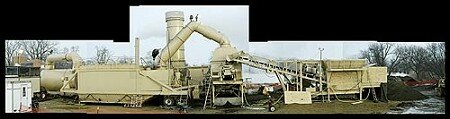 Jan -- 2008: Austin, Minnesota: The 1905-1935 Austin Light & Heating Co. gas works thermal desorption treatment is reported upon by the Austin Post-Bulletin (Nathan Howard; 16 Jan, 2008), with a view of the mobile treatment unit. Given proper site and waste characterization, competent thermal desorption program offers a high degree of risk reduction for citizens and the environment and it is a pleasure to learn that this alternative has been employed. Contaminated site soils are being removed and desorbed from a 4-foot-thick geologically-controlled stratum lying at 8-12 feet below the existing ground surface. The unit is processing the "impacted" soil and PAH tars and light oils at 25 tons per hour and the treated (at 1,800 degrees F) soils should be safe to return to the ground for completion of this phase of site remediation. Site exploration and remedial activities have been going on for at least eight years by Prof. Hatheway's account. Jan -- 2008: Austin, Minnesota: The 1905-1935 Austin Light & Heating Co. gas works thermal desorption treatment is reported upon by the Austin Post-Bulletin (Nathan Howard; 16 Jan, 2008), with a view of the mobile treatment unit. Given proper site and waste characterization, competent thermal desorption program offers a high degree of risk reduction for citizens and the environment and it is a pleasure to learn that this alternative has been employed. Contaminated site soils are being removed and desorbed from a 4-foot-thick geologically-controlled stratum lying at 8-12 feet below the existing ground surface. The unit is processing the "impacted" soil and PAH tars and light oils at 25 tons per hour and the treated (at 1,800 degrees F) soils should be safe to return to the ground for completion of this phase of site remediation. Site exploration and remedial activities have been going on for at least eight years by Prof. Hatheway's account.
---------------------------------------------------------------------------------
Jan -- 2007: British Gas Works Cleanup Law Undergoes Potentially Sweeping Changes
The United Kingdom put a Contaminated Land Policy in place in 1980, the year of CERCLA (SUPERFUND) in the United States, and gas works were then noted as general targets of remedial consideration. This was a full four years before the USEPA began to press gasworks owners to declare their sites for remedial assessment. Since that time, however, UK law has allowed gas works to be treated under the general responsibility of the privatized national gas industry. In the process, the many (perhaps 50 percent) derelict gas plants never owned or operated by British Gas plc have languished apart from Britain's strong "polluter pays" remediation policy. Just as you might expect, those pesky backyard gardeners (Bawtry, near Doncaster, Yorkshire) and those developer and infrastructure backhoes are making new discoveries of old and forgotten gas works and other coal-tar sites. Two landmark cases : 1) 2005 (Circular Facilities [London] Ltd. v. Sevenoakes District Council) and; 2) 2006 (National Grid Gas v. Environment Agency) have focused on the remedial responsibilities of those parties judged by government agencies as "knowing permitters;" roughtly equivalent to the American "responsible parties." National Grid is appealing the High Court judgment to the House of Lords, directed by the High Court, to assure a thoughtful review of the generally broad cleanup implications. Property Law Barrister Anna Rabin (London) discusses the future remedial implications of the litigation to date: (full story)
---------------------------------------------------------------------------------
Dec -- 2006: Scottish Government Removes 34 Private Homes Resting on Invergordon Gasworks Site
The Scottish Executive has allocated three-quarters of a million pounds to purchase 34 small homes that had been built atop an unremediated former town gas plant. New domiciles have been provided and the gasworks is now slated for remediation and redevelopment. Public funds have been employed here due to the lack of identification of "knowing permitters" who created the pollution. (full story)
---------------------------------------------------------------------------------
Dec -- 2006: Bay Shore, NY Residents Sue KeySpan
Some Irate Home owners in Bay Shore, and in the Incorporated Village of Brightwaters, Town of Islip, Suffolk County, New York have introduced litigation against KeySpan, the former Brooklyn Union Gas Company, for the damages suffered from the presence of gas works residuals and wastes below their residences. $40+ million is the estimated clean-up costs for the mile long underground plume of contaminated water produced by now defunct Long Island Lighting Co. manufactured gas plant.
Video report on Long Island News 12. (full TV interview)
---------------------------------------------------------------------------------
Sept -- 2006: Much Consternation over Stuyvesant Town & Peter Cooper Village, on Manhattan Island
The huge housing complex known as Stuyvesant Town and Peter Cooper Village, in the lower east side of Manhattan, was constructed between 1945 and 1947, ostensibly to provide big city housing for returning veterans of World War II. This mammoth 80 acre complex was built directly over the unremediated remains of three pioneer New York City gas works, razed to a foot below existing grade. Twenty-two thousand people have lived in these famous mid-rise apartment blocks (some 110 separate buildings) now for 60 years, mostly without knowledge of what lurks below their domiciles. Early in 2006, Metropolitan Life Insurance Company, the original developer and only owner to date, put the complex up for bid and the best estimate is that about $ 2.5 billion dollars will be offered by the successful bidder. NYSDEC has not yet declared its intent as to what degree of environmental remediation will be required to recognize this considerable environmental and public health threat. (full story)
---------------------------------------------------------------------------------
Aug -- 2006: Local Gasworks Redevelop Action in Britain Case of the Former Rochester, Chatham & Gillingham Gas Co. gasworks, Kent County (Greater London)
The Derelict Rochester Gasworks, an FMGP orphaned from those acknowledged by Lattice Group, moved forward as the focal point of the massive Thames Gateway redevelopment. £32 million will be spent on brownfield 39 ha. gasworks cleanup, making way for its part in the Medway Renaissance Project, to provide later area-housing for 100,000 people. Some light-oil bioremediation of 1 and 2-ring PAH soil contamination was employed and huge amounts of Thames River channel dredge spoil makes up the landscaping backfill. The actual management and financing has become an obligation of the South East of England Development Agency, and before the £500 redevelopment million project can get under way, the public bodies are funding the £32 million cleanup with the help of cash from the Department of Local Government and the Regions. Everybody's betting an enhanced economy to return the costs through future tax revenues. Meanwhile it would seem that "known permitters" are largely "off the hook" for paying for this outlay. (full story)
---------------------------------------------------------------------------------
June -- 2006: Public School #156 Sits On Top Of Toxic Site In Mott Haven, New York
Mott Haven, NY WCBS-TV (full TV interview)
Political reporter Marcia Kramer reports on a public school in South Bronx which sits on a toxic site and the school board plans to build four more schools on that same site.
--------------------------------------------------------------------------------
Jan -- 2005: Residents React To Gas Works Wastes At Pawtucket, R.I.
Pawtucket, R.I. (full story & photos)
Concerned gas plant neighbors at Pawtucket, Rhode Island have mounted a reasoned and planned investigation into potential presence of dumped and migrated off-site toxic wastes from the former (1885) Tidewater Gas Works of the Blackstone Valley Gas & Electric Co.
This reasoned concern is becoming a model for citizen participation where local residents have come to feel left out of the regulatory deliberations over cleanup of gas works coal tars and other toxic residuals from gas manufacturing. (click to continue)
---------------------------------------------------------------------------------
Dec -- 2004: Nocatee-Hull Creosote Site, Florida
Light oils of gas manufacturing tars represented ideal wood preservation chemicals, either untreated or treated to remove water and to thereby make the tar chemicals more penetrating of the wood to be preserved from rot and insect attack. Florida, because of its timber industry, became the site of many wood treatment plants, in which the timber was embedded with the toxic light oils of gas tars, generally in finished lumber form, and shipped away for use as utility poles, railway ties and all manner of wharf and harbor works.
The Nocatee-Hull Creosote site (1931-1952) likely is typical of many of these abandoned wood treatment sites, in which the ground became saturated with spilled, leaked and discharged treatment-fluid residues. According to the cited (below) newspaper coverage, this was one of the more primitive types of treatment, in which the wood was soaked in pits dug into the ground, rather than primarily preserved by placement in pressure-injection chambers on the ground surface. Regardless of the manner of treatment, all wood preservation sites employing coal-tars are subject to consideration as representing locations of potential human and environmental threats. Some of the sites were close to the yielding forests and relative further from population centers, and the heavy, preservation-soaked wood was shipped off the centers of supply. The Nocatee-Hull site represents such a site, one for which the magnitude of numbers of potential human receptors is relatively small and therefore the shear numbers of affected people appear to have led to its relegation to a low priority for cleanup.
Interested readers can view a recent report on the human-health threats of this site, as reported by Scott Radway of The Bradenton Hearld at the link below.
---------------------------------------------------------------------------------
Dec -- 2004: Residents say CSX polluted community
By SCOTT RADWAY - Staff Writer
The Bradenton Herald - December 17, 2004
Click Here To Read Complete Story
---------------------------------------------------------------------------------
Nov -- 2004: Tar Ponds and Coke Ovens clean up in Sydney, Nova Scotia
"London-based AMEC won a contract to prepare an environmental impact statement for the Tar Ponds and Coke Ovens clean up in Sydney, Nova Scotia. The cleanup is expected to take 10 years and cost $400 million. Cleanup plans including excavating and destroying the worst contaminants, treating remaining contaminants in place, construction of an engineered containment system, and landscaping the site. AMEC has been involved at the site during the past five years, conducting air monitoring and a peer review and quality assurance program for a soil quality study."
- CE News, November, 2004, p. 17
Note - Dr. Hatheway adds that tar originated from coke ovens constructed in 1905, at the time the steel mill was established. The plant made use of coal mined from beneath the Atlantic Ocean and operated until 1988 when Environment Canada shut the plant down, following a 1982 discovery of PAHs in lobsters harvested nearby. The cleanup has been under study since the early 1990s.
---------------------------------------------------------------------------------
Mar -- 2003: Two Acres in City on Priority Cleanup List
Click Here To Read Complete Story
BY MARY JO FELDSTEIN
Scranton Times Tribune
The Sunday Times 03/02/2003
A former manufactured gas plant in Scranton has been identified by the state's Department of Environmental Protection as one of nine priority cleanup sites.
Once home to a factory that processed coal into gaseous fuel, the 150-year-old site contains coal-tar residues, some of which may cause cancer, said Mark Carmon, a DEP spokesman.
- Scranton Times Tribune 2004
---------------------------------------------------------------------------------
|



